
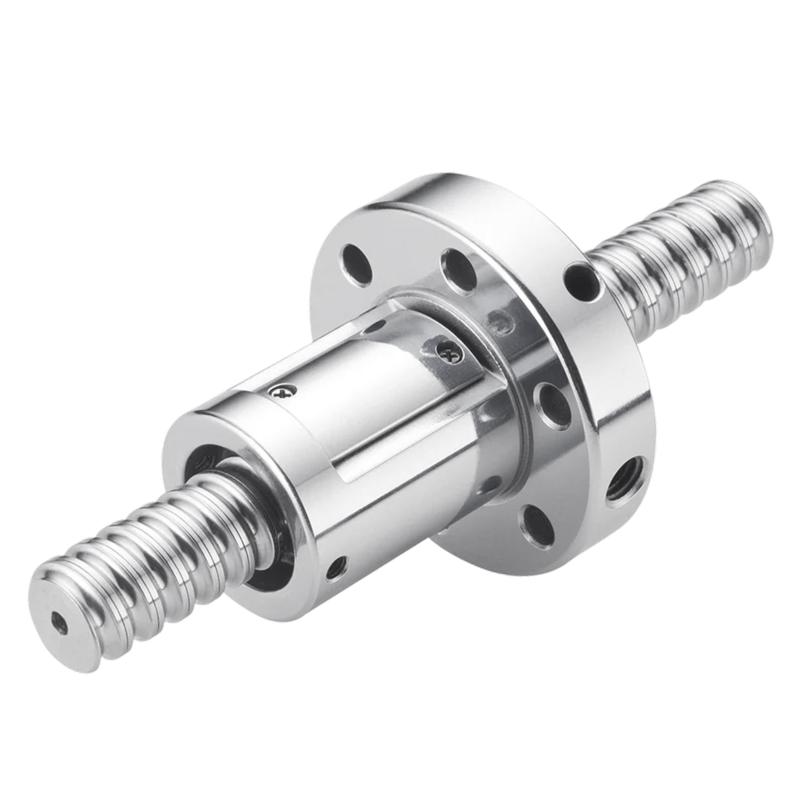
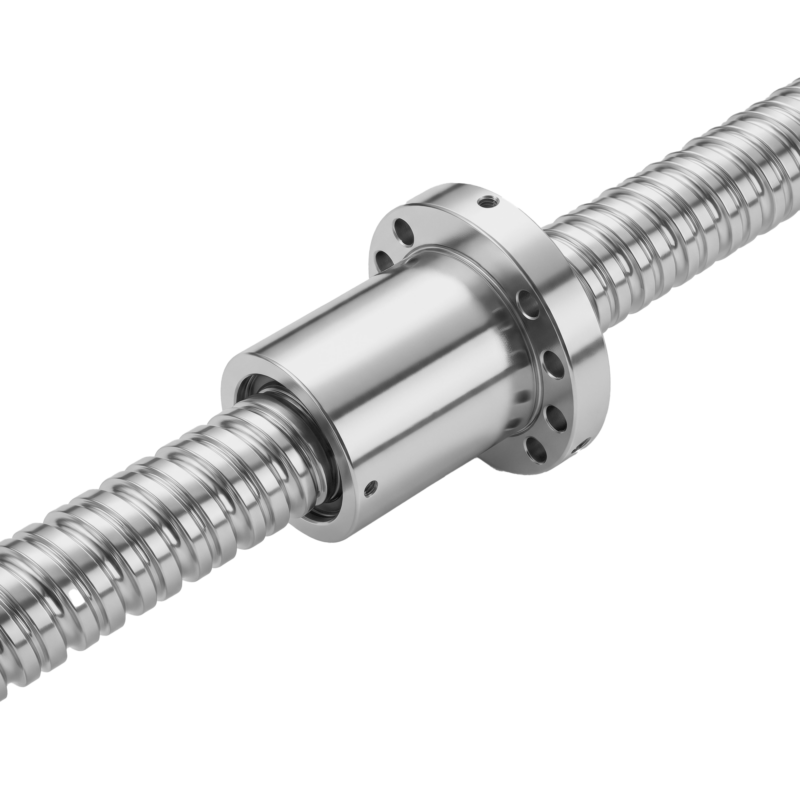
Precision Ground Ballscrews
Precision Ground Ballscrews
- Nut Configurations
- 20 standard types
- Nominal Diameter
- 6 - 100 mm
- Lead
- 1 - 50 mm
- Accuracy Grade
- JIS C0 - C7
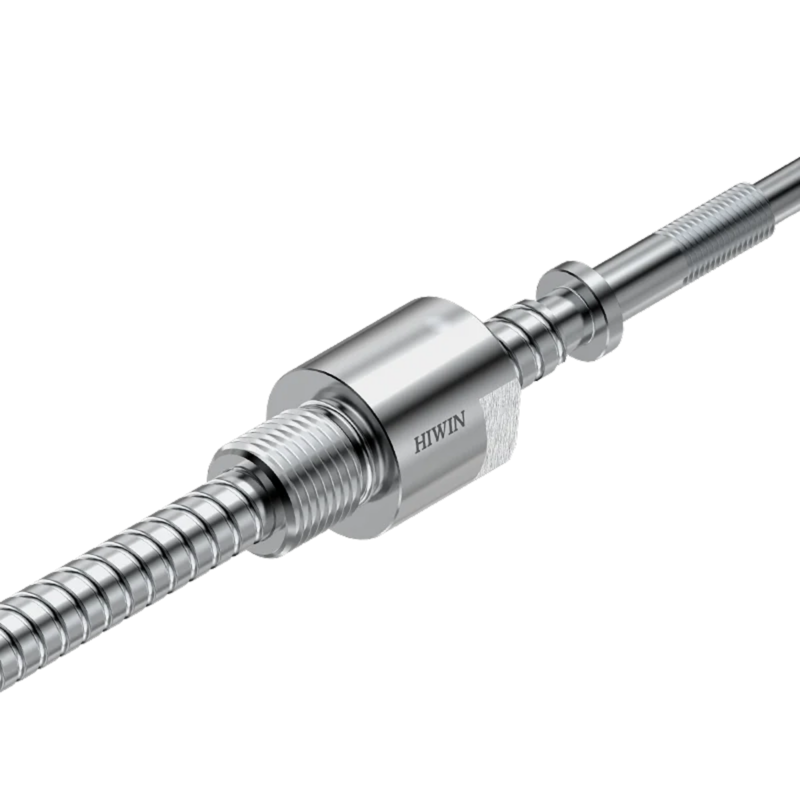
HIWIN precision ground ballscrews are ground to exact Gothic-arch groove profiles and heat treated for maximum load capacity and service life. They deliver smooth, accurate motion with low drive torque, high stiffness and quiet running, in accuracy classes from C0 (3.5 µm lead variation per 300 mm) to C7. Every ground screw is laser-measured and shipped with its accuracy report.
Precision rolled ballscrews reach grade C6 with ground-level geometry at volume pricing: the economical alternative when C3-and-finer accuracy is not required. View Rolled Ballscrews →
-
90%
Mechanical efficiency of rolling contact
-
1/3
Drive torque vs a conventional lead screw
-
3.5 µm
C0 lead variation over any 300 mm
Applications
- CNC machine centers and lathes
- Precision machine tools and grinders
- Industrial and injection molding machinery
- Electronics and semiconductor equipment
- Transport and factory automation
- Aircraft actuation
Nut configurations
Super S cassette and Super T nuts are the quiet, high-speed families; V/W tube and I internal-cap nuts cover general duty across the full diameter range; offset-preload (O) single nuts give compact zero-backlash; H end-cap and double-start types serve high leads.
| Model | Family | Nut | Circulation | Configure |
|---|---|---|---|---|
| FSZ | Super Z | Single, flange | Cassette return | Configure ↗ |
| FSC | Super S | Single, flange | Cassette return | Configure ↗ |
| FDC | Super S | Double, flange | Cassette return | Configure ↗ |
| FST | Super T | Single, flange | Tangential recirculation plate | Configure ↗ |
| FDT | Super T | Double, flange | Tangential recirculation plate | Configure ↗ |
| FSV | General | Single, flange | Return tubes above nut body | Configure ↗ |
| FSW | General | Single, flange | Return tubes within nut body | Configure ↗ |
| FDV | General | Double, flange | Return tubes above nut body | Configure ↗ |
| FDW | General | Double, flange | Return tubes within nut body | Configure ↗ |
| FSI | General | Single, flange | Internal recirculation caps | Configure ↗ |
| RSI | General | Single, round | Internal recirculation caps | Configure ↗ |
| FDI | General | Double, flange | Internal recirculation caps | Configure ↗ |
| RDI | General | Double, round | Internal recirculation caps | Configure ↗ |
| PFDW Type 1 | General | Double, flange-to-flange | Return tubes within nut body | Configure ↗ |
| PFDI | General | Double, flange-to-flange | Internal recirculation caps | Configure ↗ |
| OFSW | General | Single, offset preload | Return tubes within nut body | Configure ↗ |
| OFSI | General | Single, offset preload | Internal recirculation caps | Configure ↗ |
| FSH | High lead | Single, flange | End cap return | Configure ↗ |
| DFSV | High lead | Single, double start | Return tubes above nut body | Configure ↗ |
| PFDW Type 2 | High lead | Double, compression preload | Return tubes within nut body | Configure ↗ |
Part numbers & options
How a part number reads
1R40 - 10B2 - PFDWE2 - 800 - 1000 - 0.0035 - M
- 1
- Start type — 1 single to 5 five-start
- R
- Right-hand screw (left-hand on request)
- 40
- Nominal diameter (mm) — 6 to 100
- 10
- Lead (mm) — 1 to 50
- B2
- Turns per circuit — A 1.5 · B 2.5 · C 3.5 (×2 = two circuits) · T3/T4/T5/T6 = 3/4/5/6 turns · S1/S2/S4 = 1.8×1/×2/×4 · U1/U2 = 2.8×1/×2 · V2 = 0.8×2 · K2/K3/K4 = 2/3/4 turns · X/Y/Z = 2.8/3.8/4.8
- P
- Preload type — P compression · O offset pitch
- Q
- Nut start type, high-lead nuts only — D double · T triple · Q quaternary · F five start
- F
- Nut shape — F flange · S square · R round
- D
- Nut type — S single · D double
- W
- Circulation — V/W tubes · B bonded tube · I internal cap · H end cap · C Super S · T Super T · P/S RD series
- E2
- Optional functions — E2 self-lube · R1 rotating nut · C1/C2 cool type · Q1 spacer
- 800
- Thread length (mm)
- 1000
- Total length (mm)
- 0.0035
- Lead deviation over random 300 mm (mm)
- M
- Execution — M stainless · D biaxial · H hollow shaft · L heavy load
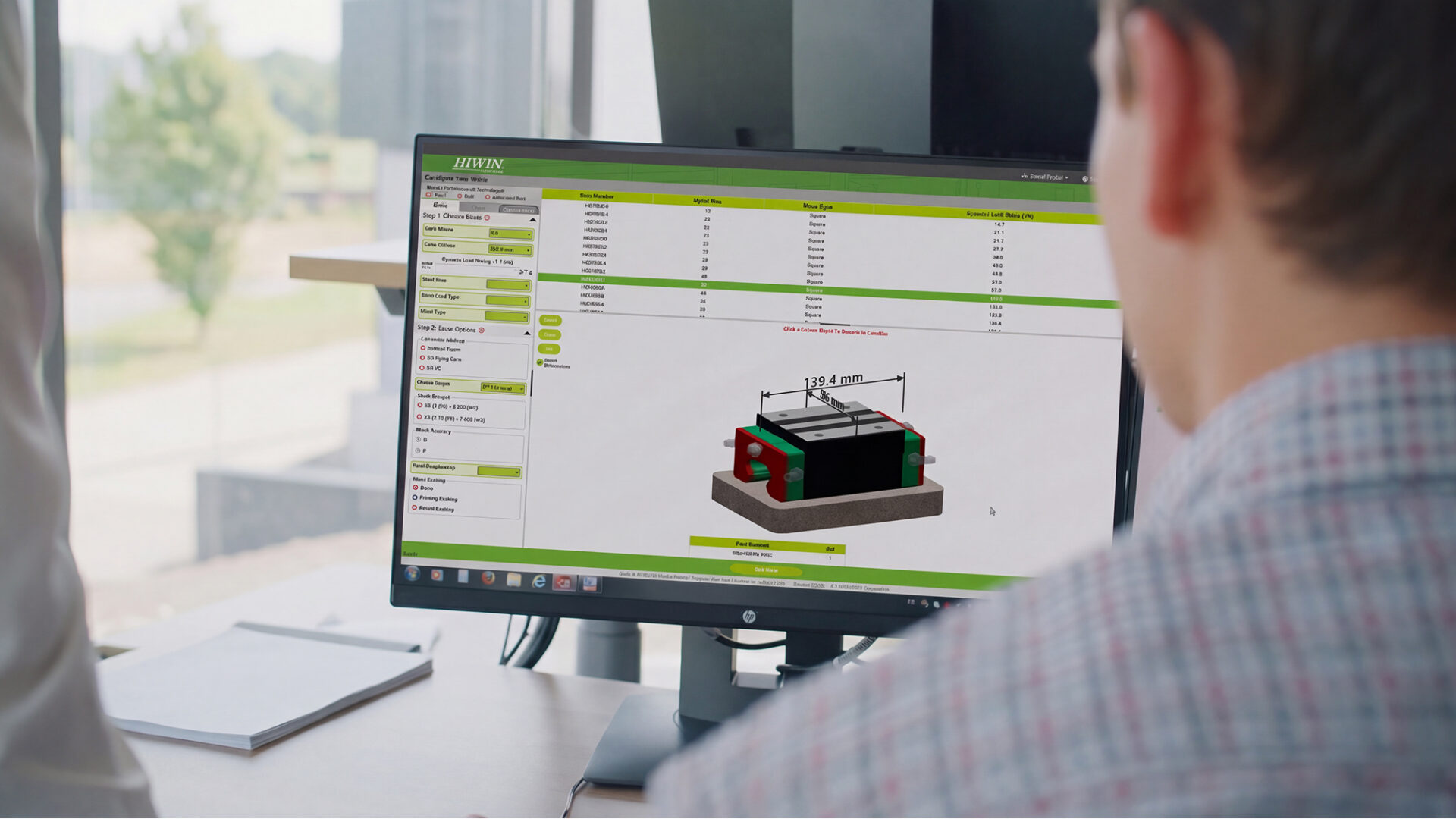
The configurator assembles this number for you, with drawings and 3D CAD. Configure ↗
Accuracy grades
Grades are set by lead variation over any 300 mm of travel. Ground screws run C0 to C7.
- C0 3.5 µm / 300 mm — Jig borers, measuring machines, aviation
- C1 5 µm / 300 mm — Precision grinders and lathes
- C2 6 µm / 300 mm — High-accuracy machine centers
- C3 8 µm / 300 mm — Machine centers, milling, EDM
- C4 12 µm / 300 mm — Lathes, drilling machines, punching presses
- C5 18 µm / 300 mm — General CNC axes, drilling
- C6 23 µm / 300 mm — General industrial robots, single-purpose machines
- C7 50 µm / 300 mm — Transport and general machinery
Preload methods
Backlash is removed by an internal preload force; best preload stays below 5% of dynamic load C. Preload type codes: P compression · O offset.
- — Double nut + spacer (nut type D) — Tension preload, the precision standard
- O Offset-pitch single nut — Compact, high stiffness from a pitch offset
- — Oversized-ball single nut — Light preload, four-point ball contact
Optional functions
Appended to the nut code in the model number.
- E2 Self-lubrication — Lubricant reservoir extends service intervals
- R1 Rotating nut — Nut-driven axes; the screw stays still
- C1/C2 Cool type — Forced cooling against thermal growth
- Q1 Spacer — Spacer balls for smoother torque
Special executions
- M Stainless steel — Corrosion resistance
- H Hollow shaft — Coolant passage or weight reduction
- L Heavy load — Reinforced heavy-duty execution
- D Biaxial movement
Other Ballscrews & Supports
-
-
-
-
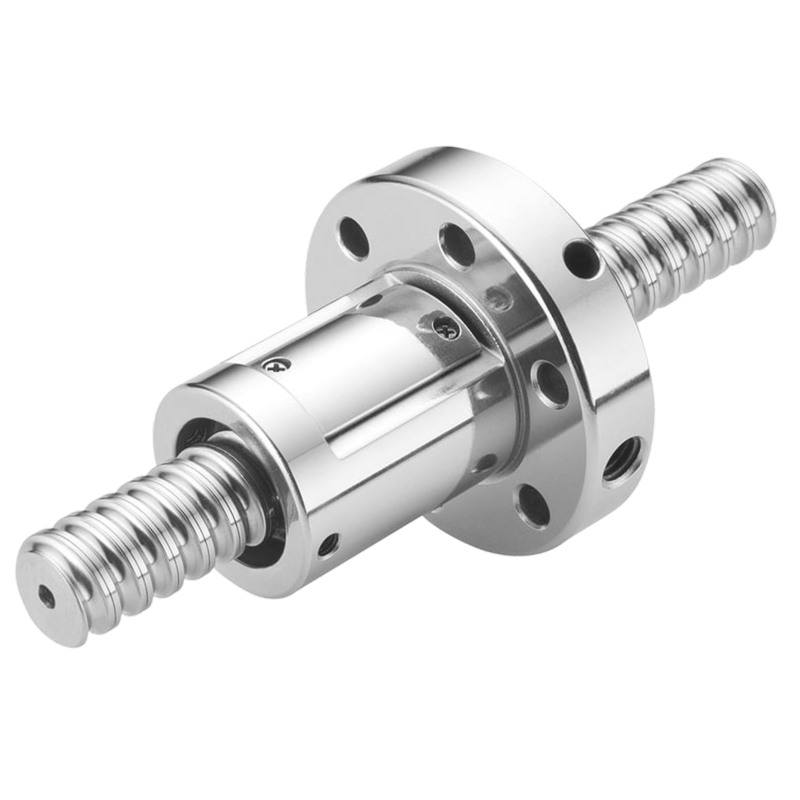
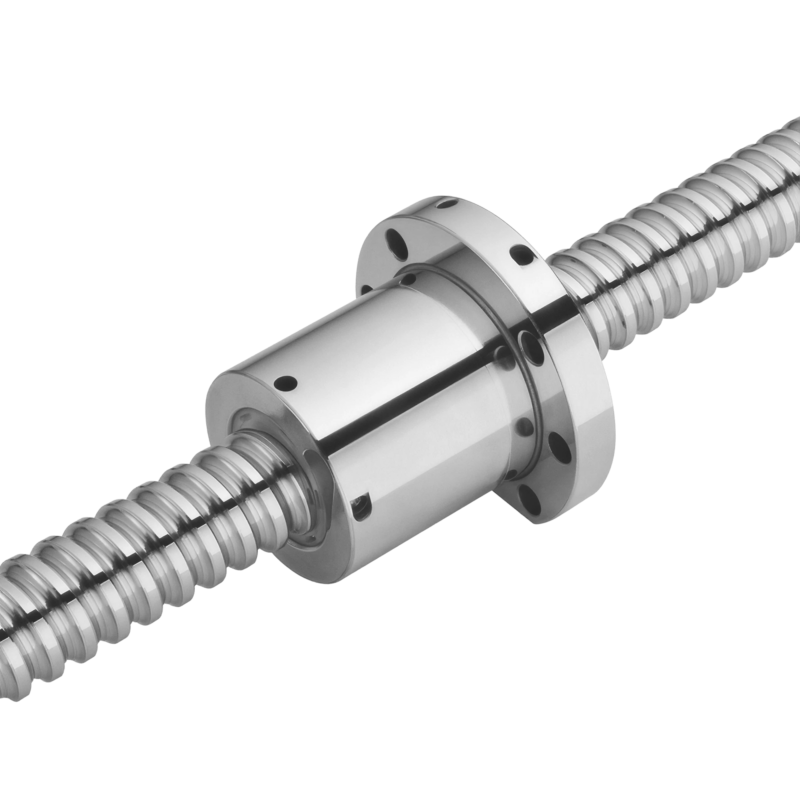
Super Z Series
High-Speed Low-Noise Ballscrew with Cassette-Type Circulation
Ballscrews & Supports
-
How buying works
Spec it in the configurator: drawings, 3D CAD, and a quote to follow.
HIWIN series are configured to your application, not bought off the shelf. Start from your loads and speeds if you are still choosing a size.
Rather talk it through? Request a quote from an application engineer.