
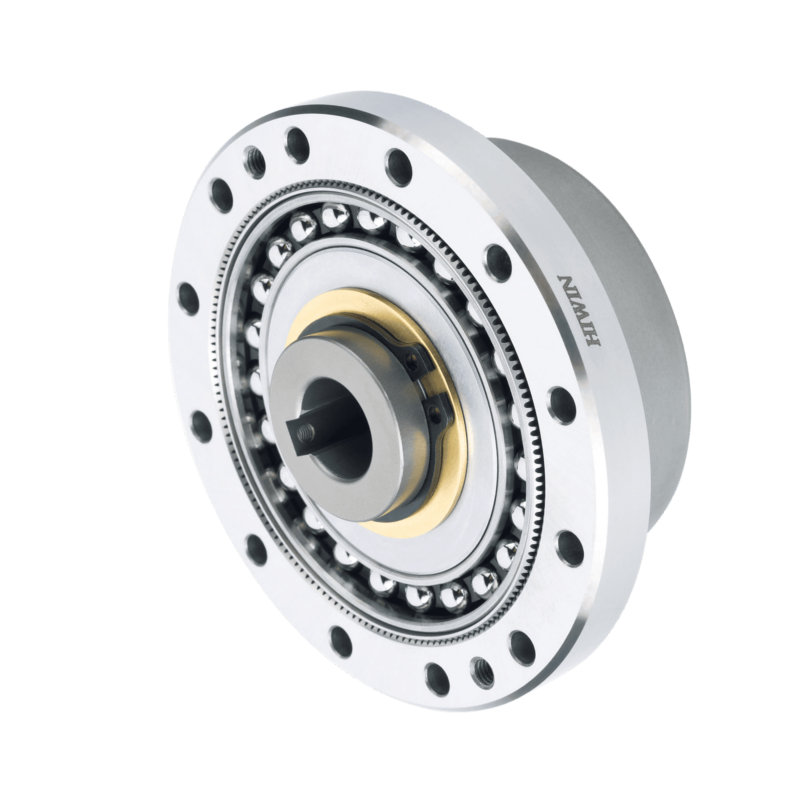
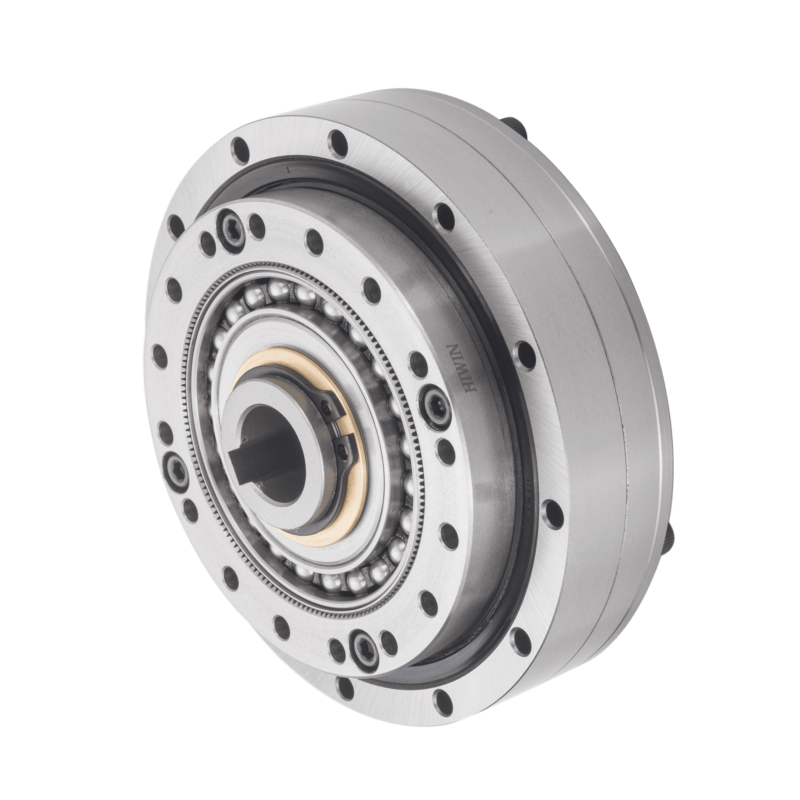
DSC-PO Series
DSC-PO Combination Strain Wave Gear Unit with Output Bearing
- Type
- Combination unit (PO): Oldham input, crossed roller output bearing
- Models
- 14 - 40 (6 sizes)
- Reduction Ratios
- 50 - 160
- Rated Torque
- 5.4 - 294 Nm
The DSC-PO packs the DATORKER strain wave mechanism, a wave generator flexing a cup-type flex spline inside a flange-type circular spline, into a unit that arrives assembled and lubricated. A crossed roller bearing is built into the output, so the gear takes axial and radial load directly while delivering the high single-stage ratios of the strain wave design.
Need 30% more torque from the same cup-type unit? DGC-PO is the heavy-load build. View DGC-PO Series →
-
1 arc min
Angle transmission accuracy, models 20 to 40
-
647 Nm
Peak start/stop torque (DSC-40-160)
-
4.55 kN
Permissible axial load on the output bearing (model 40)
Applications
- Robot joints
- Automation equipment
- Semiconductor equipment
- Machine tools
- Inspection equipment
Models & ratios
Rated torque is at 2,000 rpm input; peak torque covers start and stop. Ratios 120 and 160 are not available on the smallest models. A customized code is appended where used, e.g. DSC-25-80-PO-C.
| Model number | Reduction ratio | Rated torque (Nm) | Peak torque (Nm) | Configure |
|---|---|---|---|---|
| DSC-14-50-PO | 50 | 5.4 | 18 | Configure ↗ |
| DSC-14-80-PO | 80 | 7.8 | 23 | Configure ↗ |
| DSC-14-100-PO | 100 | 7.8 | 28 | Configure ↗ |
| DSC-17-50-PO | 50 | 16 | 34 | Configure ↗ |
| DSC-17-80-PO | 80 | 22 | 43 | Configure ↗ |
| DSC-17-100-PO | 100 | 24 | 54 | Configure ↗ |
| DSC-17-120-PO | 120 | 24 | 54 | Configure ↗ |
| DSC-20-50-PO | 50 | 25 | 56 | Configure ↗ |
| DSC-20-80-PO | 80 | 34 | 74 | Configure ↗ |
| DSC-20-100-PO | 100 | 40 | 82 | Configure ↗ |
| DSC-20-120-PO | 120 | 40 | 87 | Configure ↗ |
| DSC-20-160-PO | 160 | 40 | 92 | Configure ↗ |
| DSC-25-50-PO | 50 | 39 | 98 | Configure ↗ |
| DSC-25-80-PO | 80 | 63 | 137 | Configure ↗ |
| DSC-25-100-PO | 100 | 67 | 157 | Configure ↗ |
| DSC-25-120-PO | 120 | 67 | 167 | Configure ↗ |
| DSC-25-160-PO | 160 | 67 | 176 | Configure ↗ |
| DSC-32-50-PO | 50 | 76 | 216 | Configure ↗ |
| DSC-32-80-PO | 80 | 118 | 304 | Configure ↗ |
| DSC-32-100-PO | 100 | 137 | 333 | Configure ↗ |
| DSC-32-120-PO | 120 | 137 | 353 | Configure ↗ |
| DSC-32-160-PO | 160 | 137 | 372 | Configure ↗ |
| DSC-40-50-PO | 50 | 137 | 402 | Configure ↗ |
| DSC-40-80-PO | 80 | 206 | 519 | Configure ↗ |
| DSC-40-100-PO | 100 | 265 | 568 | Configure ↗ |
| DSC-40-120-PO | 120 | 294 | 617 | Configure ↗ |
| DSC-40-160-PO | 160 | 294 | 647 | Configure ↗ |
Part numbers & options
How a part number reads
DSC - 25 - 80 - PO - C
- DSC
- Type — D DATORKER · S standard (G heavy load) · C cup flex spline
- 25
- Model — 14, 17, 20, 25, 32, 40
- 80
- Reduction ratio — 50, 80, 100, 120, 160
- PO
- Module + input — P combination (output bearing built in) · O Oldham coupling
- C
- Customized — M high tilting moment · L lightweight · S surface treatment · C customized (blank = standard)
The configurator assembles this number for you, with drawings and 3D CAD. Configure ↗
Series tiers
The second letter of the type code picks the tier; the PO combination module comes in standard and heavy load.
- S Standard (DSC-PO) — The base tier
- G Heavy load (DGC-PO) — Higher torque load and life than standard
Customized executions
The trailing code of the model number; blank means standard.
- M High tilting moment (DSC-PO-M) — Higher loading capacity of the output bearing
- L Lightweight — Weight-reduced execution
- S Surface treatment — Environmental protection
- C Customized — Built to customer requirement
Other DATORKER® Strain Wave Gearing Systems

How buying works
Spec it in the configurator: drawings, 3D CAD, and a quote to follow.
HIWIN series are configured to your application, not bought off the shelf. Start from your loads and speeds if you are still choosing a size.
Rather talk it through? Request a quote from an application engineer.