
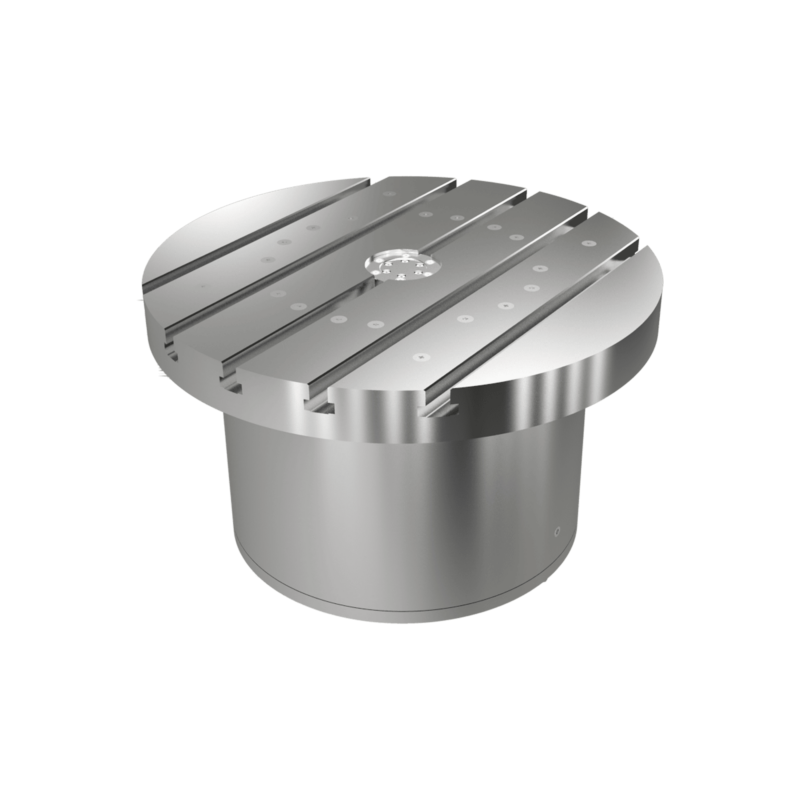
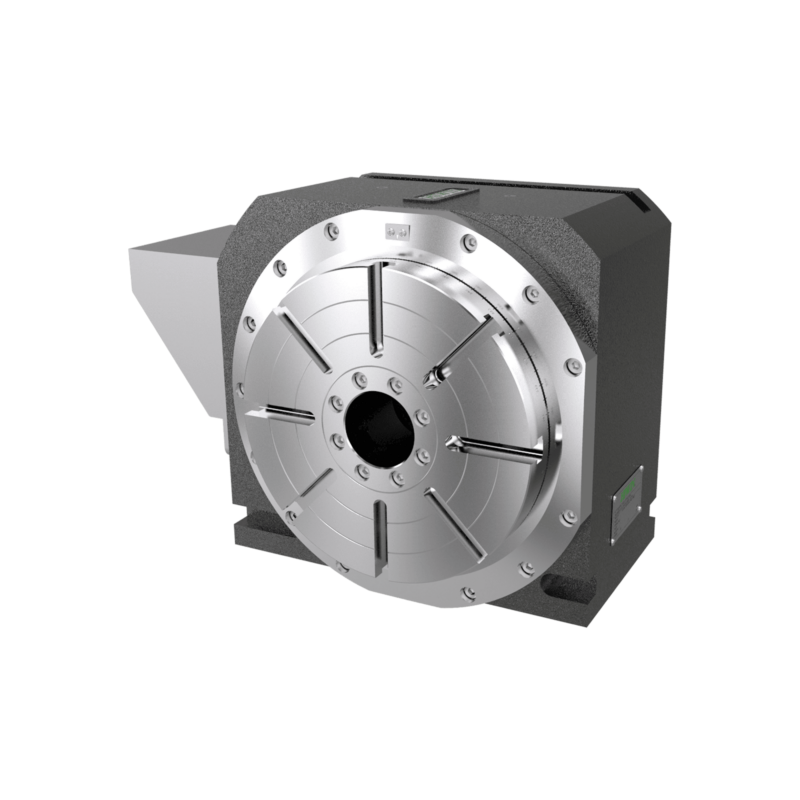
RCV Series
RCV Single-Axis Vertical Rotary Table
- Type
- Single-axis vertical
- Models
- 8 (table Ø 100 - 500 mm)
- Positioning Accuracy
- ±5 arc-sec, all but one build
- Allowable Load
- 10 - 800 kg
The RCV is the vertical single-axis choice for upgrading a processing machine to 3+1 axis. A built-in torque motor delivers high acceleration, high torque and zero backlash, with no worm gear or roller cam in the drive path, and a high-rigidity radial-axial bearing carries radial load, bidirectional axial load and overturning moment on one race. Eight table sizes from Ø100 to Ø500 mm reach 2,400 N·m of torque, and a high-precision encoder holds ±5 arc-second positioning accuracy with 4 arc-second repeatability on all but one build. IP68 underwater builds of the RCV-100 and RCV-125 run fully immersed for wire-cut EDM, with an optional 1,000 rpm high-speed table.
RCH is the horizontal counterpart for integrated milling, turning and grinding. View RCH Series →
-
±5 arc-sec
Positioning accuracy with 4 arc-sec repeatability, 13 of 14 builds
-
2,400 N·m
Max torque (RCV-500)
-
1,000 rpm
Optional speed, IP68 underwater RCV-125
Applications
- Die and mold machining
- Metal parts machining
- Tool machining
- Electronic parts machining
- Tool grinding and gear cutting
- Medical industry parts machining
- Automotive parts machining
- Wire-cut EDM and underwater ultrasonic testing
Models
Several sizes come in more than one build. The IP68 RCV-100 and RCV-125 are the underwater EDM tables (the Underwater brochure names them RCV-100E and RCV-125E); the BT50 RCV-100 is a water-cooled tool-grinding build with a BT50 taper. RCV-170 comes in three: a convection-cooled base build (rated ±15 arc-sec, 8 arc-sec repeatability, the range's one exception), a water-cooled build, and a Ø40 through-hole grinding build. RCV-400 adds a Ø70 through-hole high-torque build and a hydraulic-clamped 5 degree index build, both spindle-ready for mill-turn work with no printed allowable load.
| Model | Table Ø (mm) | Max torque (N·m) | Max speed (rpm) | Allowable load (kg) | Configure |
|---|---|---|---|---|---|
| RCV-100 (IP68) | 105 | 20.9 | 200 | 10 | Configure ↗ |
| RCV-100 (BT50) | 100 | 83.1 | 200 | 20 | Configure ↗ |
| RCV-125 (IP68) | 125 | 33.8 | 200 / 1,000 opt. | 20 | Configure ↗ |
| RCV-125 | 125 | 59.4 | 400 | 20 | Configure ↗ |
| RCV-170 | 170 | 188 | 150 | 50 | Configure ↗ |
| RCV-170 (WC) | 170 | 203 | 200 | 70 | Configure ↗ |
| RCV-170 (grinding) | 170 | 160 | 200 | 50 | Configure ↗ |
| RCV-230 | 230 | 390 | 60 | 150 | Configure ↗ |
| RCV-250 | 250 | 280 | 140 | 160 | Configure ↗ |
| RCV-320 | 320 | 640 | 60 | 200 | Configure ↗ |
| RCV-400 | 400 | 810 | 90 | 250 | Configure ↗ |
| RCV-400 (Ø70) | 400 | 1,360 | 50 | - | Configure ↗ |
| RCV-400 (5° index) | 400 | 1,160 | 100 | - | Configure ↗ |
| RCV-500 | 500 | 2,400 | 25 | 800 | Configure ↗ |
Part numbers & options
How a part number reads
RCV - 125 E (Ø125 mm single-axis vertical table, IP68 underwater build)
- RCV
- Series — single-axis vertical torque motor rotary table
- 125
- Table diameter — 100 · 125 · 170 · 230 · 250 · 320 · 400 · 500 mm
- E
- Underwater build — IP68 EDM table (RCV-100E · RCV-125E), omitted on standard builds
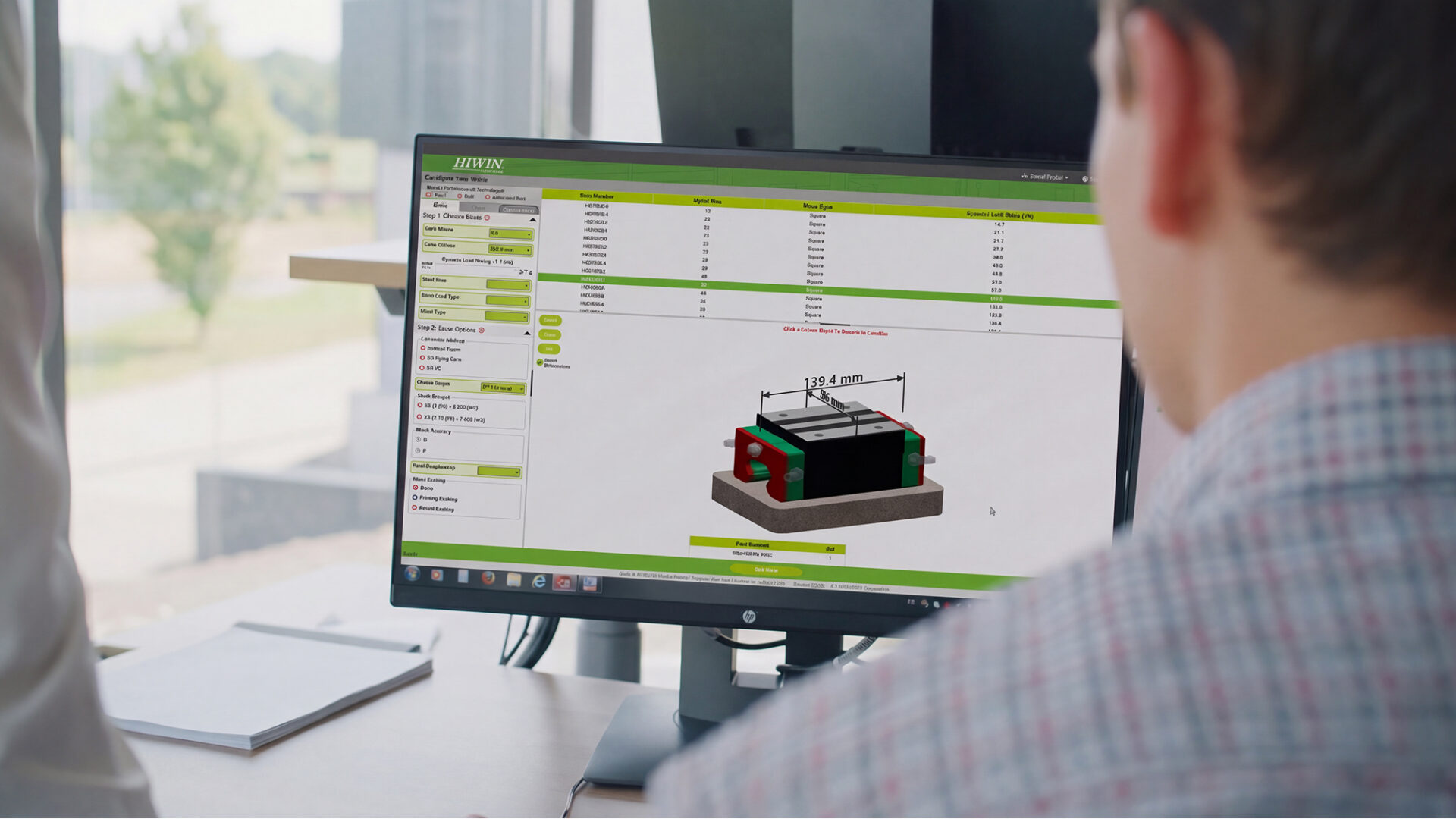
The configurator assembles this number for you, with drawings and 3D CAD. Configure ↗
Clamping system
Holding torque that locks the table through power loss.
- Pneu Full-circumference pneumatic (6 bar) — RCV-125 through RCV-500: 100 - 2,400 N·m holding torque
- Hyd Hydraulic gear type (55 bar) — RCV-400 index build: 7,200 N·m in 5 degree increments
- EM Electromagnetic — IP68 RCV-125: 9 N·m
- — None — RCV-100 builds, the RCV-170 grinding build and RCV-230 run unclamped
Cooling
- — Convection — Both IP68 builds and the base RCV-170
- WC Water cooled — Every other build, up to 8,262 W cooling power on the RCV-500
Tailstock
The catalog's selection guide offers tailstocks for the RCV series alone.
- RT Rotary tailstock
- T Tailstock
Other Rotary Tables
How buying works
Spec it in the configurator: drawings, 3D CAD, and a quote to follow.
HIWIN series are configured to your application, not bought off the shelf. Start from your loads and speeds if you are still choosing a size.
Rather talk it through? Request a quote from an application engineer.