
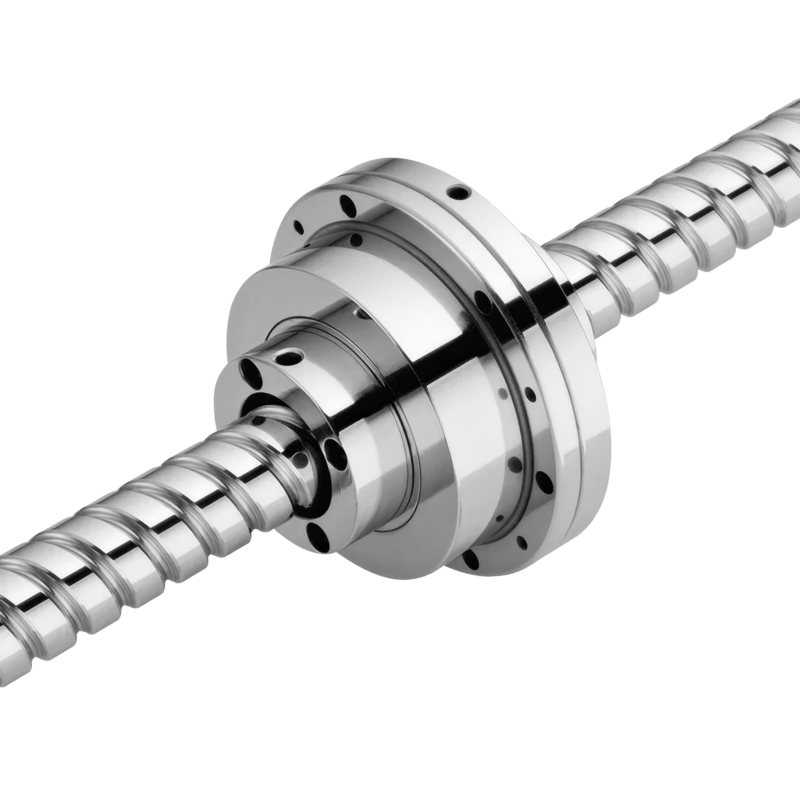
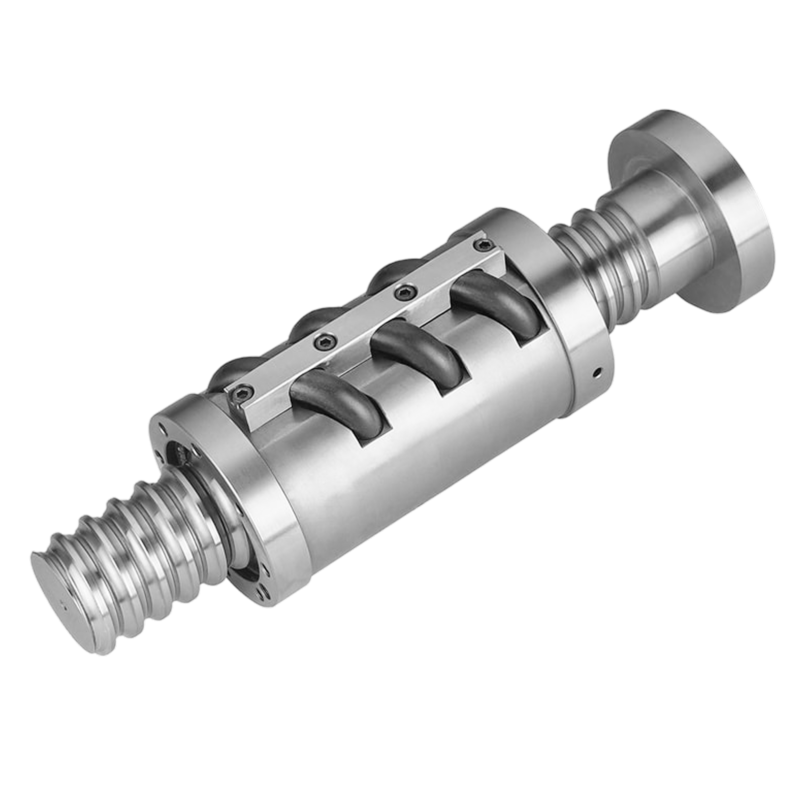
Heavy Load Series
HL Series Heavy Load Ballscrews
- Nut Configurations
- 4 types (FSV, FSC, FSP, FSS)
- Nominal Diameter
- 32 - 125 mm
- Lead
- 10 - 50 mm
- Accuracy Grade
- JIS C7
- Dm-N Value
- Max. 130,000 - 160,000 (by circulation type)
Heavy load ballscrews offer 2-3 times higher loading capacity than a standard ballscrew series. They have reinforced circulation systems that are suitable for high speed conditions and are able to achieve a longer service life.
-
2-3×
Load capacity vs a standard ballscrew series
-
160,000
Max Dm-N value with tangent return (Super S and RD types)
-
5-7 dBA
Quieter than a traditional external return (RD tangent return with spacers)
Applications
- All-electric injection molding machines
- Die-cast machines
- Semiconductor manufacturing machines
- Heavy duty actuators
- Forging machines
Nut configurations
All four Heavy Load nuts are flanged single nuts; the code reads flange (F), single (S), then the circulation system (V external tubes, C Super S cassette, P or S for the RD tangent systems). The external return type FSV covers Ø40-125 mm at leads 10-25 mm (Dm-N to 130,000); the Super S cassette FSC covers Ø50-80 mm at leads 30-50 mm and the RD types reach Ø36-125 mm at leads 10-50 mm, both with Dm-N to 160,000 (Q1 spacers available).
| Model | Family | Nut | Circulation | Configure |
|---|---|---|---|---|
| FSV | External Return Type | Single, flange | Return tubes above nut body, reinforced deflector | Configure ↗ |
| FSC | Super S Type | Single, flange | Cassette tangent return | Configure ↗ |
| FSP | RD Series | Single, flange | Tangent return, tubes above nut body | Configure ↗ |
| FSS | RD Series | Single, flange | Tangent return, tubes within nut body | Configure ↗ |
Part numbers & options
How a part number reads
1R40 - 10B2 - PFDWE2 - 800 - 1000 - 0.0035 - M (spaces between decoded positions)
- 1
- Start type — 1 single · 2 double · 3 triple · 4 four · 5 five (HL models with 2R prefixes are double start)
- R
- Right-hand screw (left-hand on request)
- 40
- Nominal diameter (mm) — 32 to 125 in this series
- 10
- Lead (mm) — 10 to 50 in this series
- B2
- Turns × circuits — B 2.5 · C 3.5 · X 2.8 · Y 3.8 · Z 4.8, digit = circuits · K6/K8 = cassette circuit count
- P
- Preload type — P compression · O offset (Heavy Load nuts are supplied without preload)
- F
- Nut shape — F flange · S square · R round
- D
- Nut type — S single · D double
- W
- Circulation — V/W tubes · I internal cap · H end cap · C Super S · P RD, tubes above nut body · S RD, tubes within nut body
- E2
- Optional functions — Q1 spacer · E2 self-lubrication · R1 rotating nut · C1/C2 cool type
- 800
- Thread length (mm)
- 1000
- Total length (mm)
- 0.0035
- Lead deviation over random 300 mm travel (mm)
- M
- Execution — L heavy load · M stainless · H hollow shaft · D biaxial movement
The configurator assembles this number for you, with drawings and 3D CAD. Configure ↗
Accuracy grade
Heavy Load (HL) ballscrews are supplied to standard accuracy JIS C7 (0.05 mm), defined by lead variation over 300 mm of travel.
- C7 0.05 mm / 300 mm — JIS grade C7 is the standard for the HL Series.
Preload and backlash
To protect service life and avoid excessive temperature rise under heavy load, HL nuts are not preloaded.
- None Non-preloaded nut — Standard axial backlash is 0.02-0.05 mm max.
Optional functions
The tangent-return types can be built with ball spacers.
- Q1 Ball spacers — Eliminates ball-to-ball impact in high-load operation to extend service life; recommended for temperatures not exceeding 70 °C.
Lubrication
Sufficient lubrication is required to reach rated service life; grease deteriorates with use, so relubricate periodically.
- G01 HIWIN G01 series grease — Use grease with extreme-pressure additives; a lubrication hole on each circuit is recommended so grease reaches the screw directly.
Other Ballscrews & Supports
How buying works
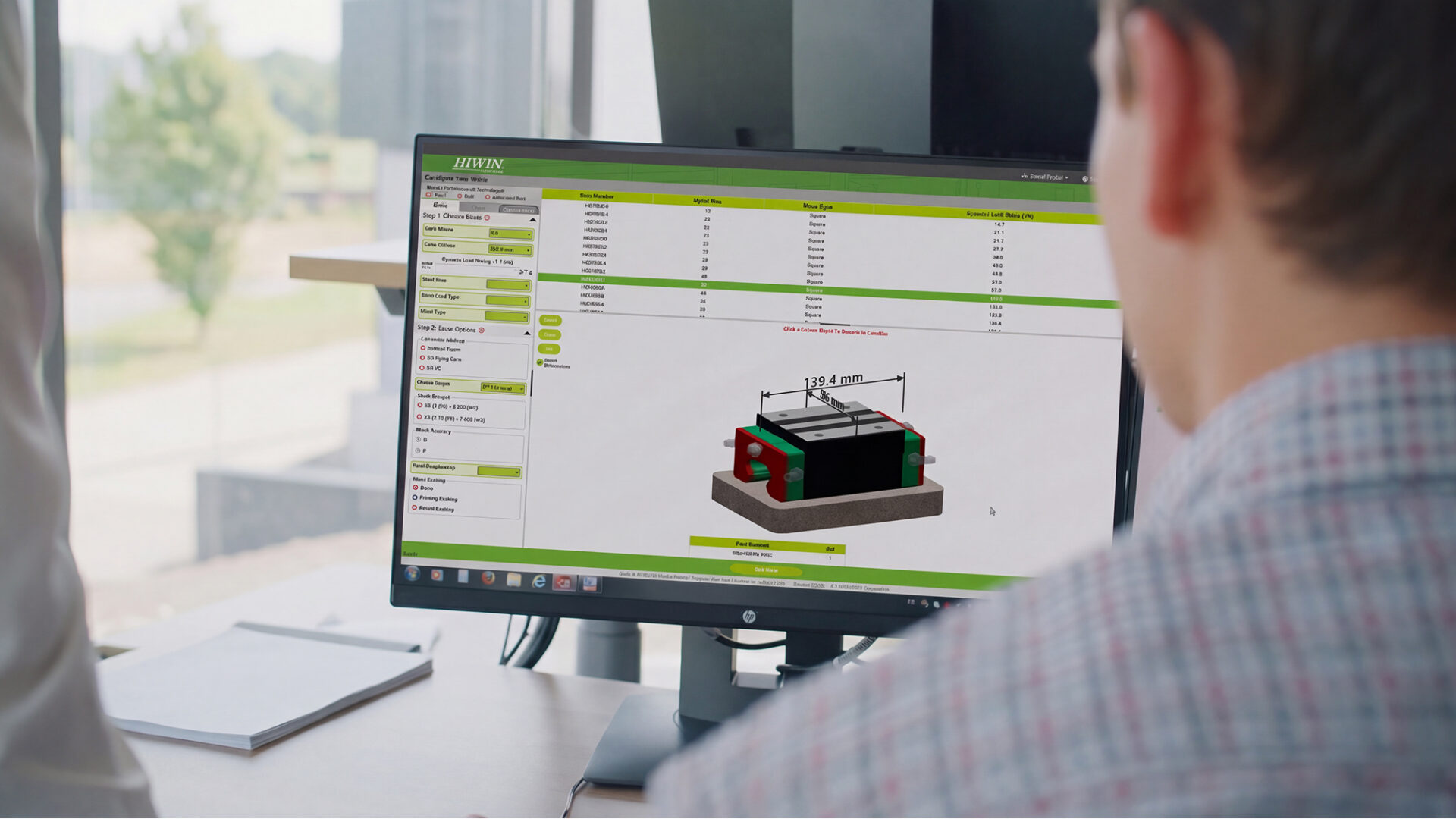
Spec it in the configurator: drawings, 3D CAD, and a quote to follow.
HIWIN series are configured to your application, not bought off the shelf. Start from your loads and speeds if you are still choosing a size.
Rather talk it through? Request a quote from an application engineer.