HIWIN products run from precision components such as guideways and ballscrews, through compact single-axis stages, to full systems combining several axes with motors, drives, and controllers. Linear stages sit in the middle of that range. Driven by a ballscrew, a belt, or a linear motor, these compact and customizable units both propel and guide the payload along a single axis, standalone or combined into a multi-axis system, in applications from woodworking to additive manufacturing to semiconductor processing and metrology.
2,250+
Patents held by HIWIN worldwide
34
Countries where those patents are registered
5 of 6
Degrees of freedom the guideway restricts
What a linear stage is
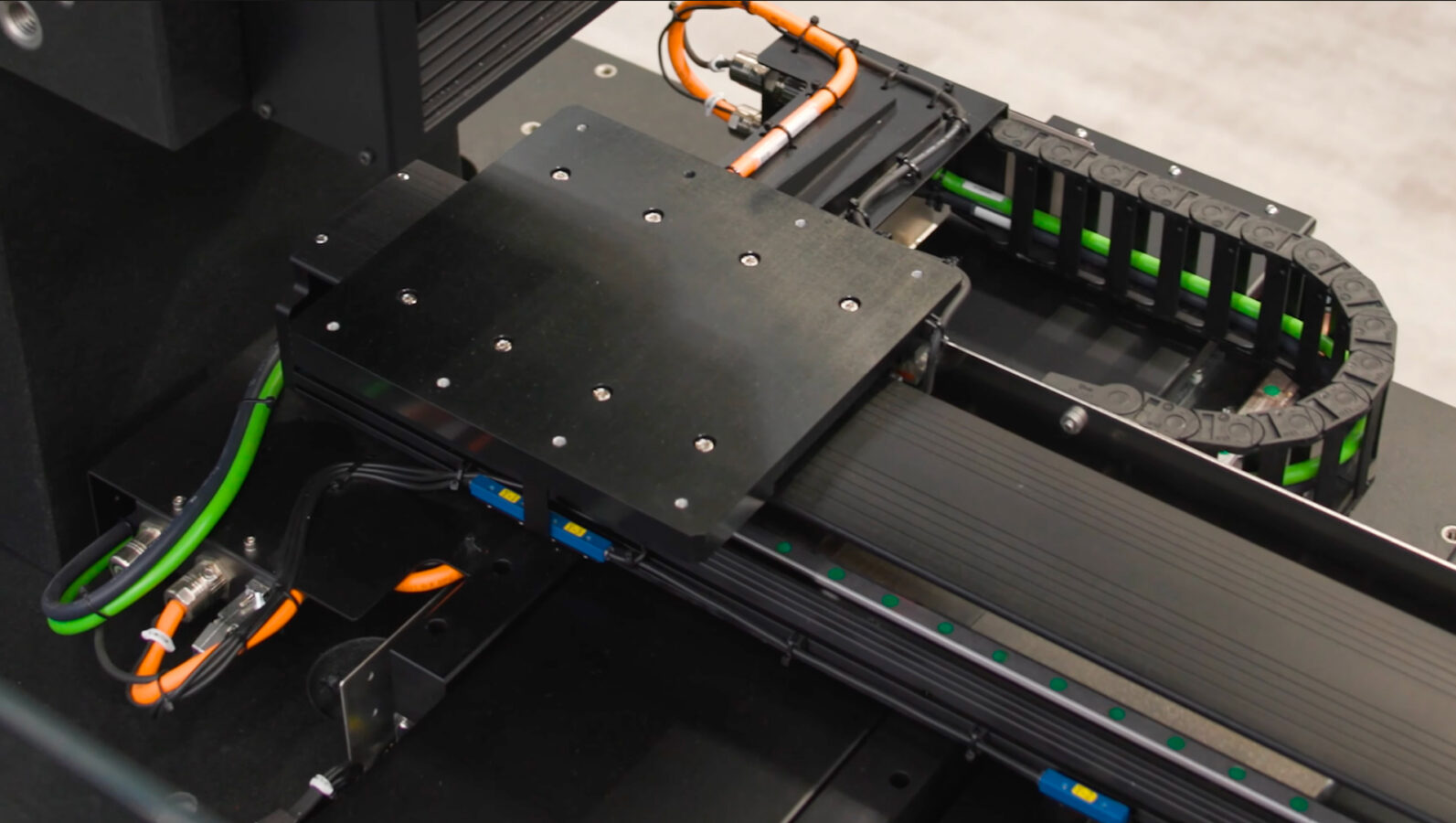
Also called translation or linear motion stages, they are positioning devices. At their simplest they consist of a drive mechanism that propels the load, a bearing or guideway that handles non-axial loading and keeps the load traveling straight, and a base tying the two together. A motor drives the stage, either integrated into it or easily coupled to it. Position feedback is either direct, as with a linear encoder on the stage, or indirect, as with a rotary encoder on the motor turning the belt or ballscrew. Dust protection and cable management are usually designed in from the start.
The essential job is precise, repeatable motion of the carriage relative to the base. Pre-assembling those elements into a stage means the precision alignment between drive and guidance components is the manufacturer’s problem, not the customer’s. That modularity is also what lets end users, integrators, and manufacturers stack stages into multi-axis systems: cantilevered x-y, gantry, and x-y-z structures are the common ones.
How they work
Ballscrew and belt drives both convert the torque and rotational speed of a rotary motor into force and linear velocity along the axis of travel. In a linear motor stage, the magnet track runs the full length of the axis and the motor drives the motion directly. Because the drive is only there to provide axial force, a guideway handles everything else: the guide component restricts five of the six degrees of freedom so the moving platform travels linearly and repeatably.
Precision stages are typically driven by a servo motor and drive, often under a programmable controller, which means closed-loop feedback. Linear motor stages use a linear encoder, with the scale mounted along the axis and the read head traveling with the payload. Ballscrew and belt stages usually use the rotary encoder built into the servo motor, though they can be designed to take direct linear feedback instead. Some drives, the HIWIN E1 among them, accept dual-loop feedback and use both the motor encoder and a linear encoder together.
Why the category keeps growing
Precision, performance, control, and cost-effectiveness have all improved over the past few decades, and demand has risen with computerized control and the wider push toward automation and Industry 4.0. What makes the category durable is the simplicity of the underlying principle, which is what leaves room for stages that are both highly reliable and genuinely innovative: customized, dust-proof, straightforward to install, and quiet on far less energy than the alternatives.