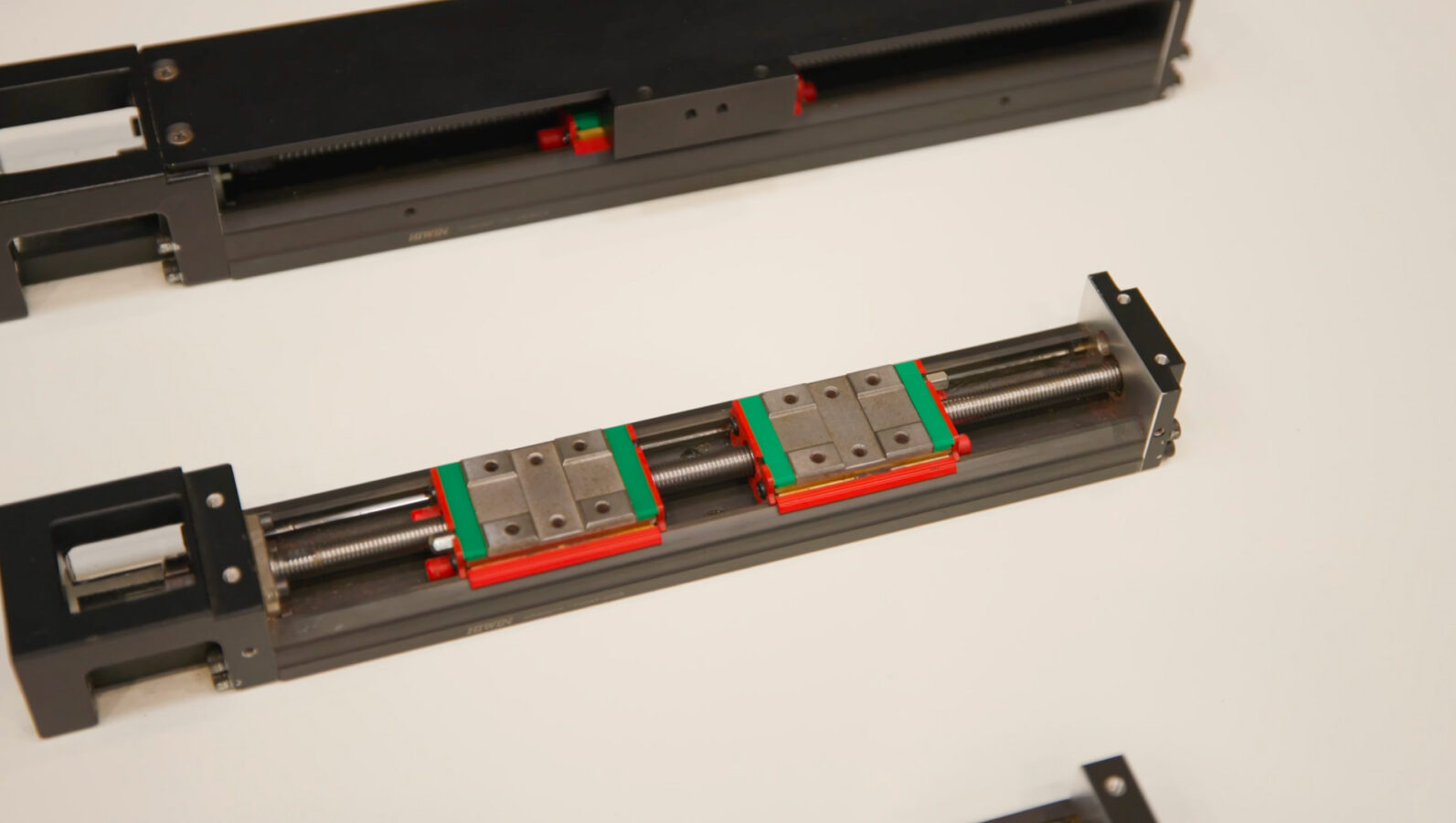
Linear motors turn electrical energy into contactless driven linear motion. They are used wherever precision matters across a wide range of industries, automation, semiconductor, and medical among them.
1,579 N
LMSA iron-core, maximum continuous force
7,917 N
LMFA water-cooled, maximum continuous force
1,003 N
LMC ironless, maximum continuous force
What a linear motor is
HIWIN builds permanent magnet linear synchronous motors. They work on the same principles as a standard three-phase permanent magnet rotary motor and share its structure: cut a three-phase AC synchronous motor along an edge, flatten it out, and the rotary motor becomes a linear one, producing force along a line rather than torque about an axis.
Against other drive mechanisms, linear motors are low maintenance, respond quickly, and are backlash-free. Where design time is the constraint, the same motors are available already built into single-axis stages or multi-axis systems as a drop-in solution.
How they work
A conventional three-phase AC synchronous rotary motor uses a central rotor carrying magnets inside a stationary coil that generates a rotating magnetic field. A linear motor follows the same principle, but the coil is typically the moving part and the magnets are stationary, usually high-strength permanent magnets to raise force density.
Every HIWIN motor is a closed-loop servo and requires a position feedback system, normally a linear encoder. The servo drive uses feedback from the moving carriage to coordinate output across the three phases, which is what produces smooth motion and high positional accuracy.
Iron-core motors
Iron-core motors suit high-speed, high-acceleration, point-to-point work, delivering roughly 0.5 to 0.75 N per cubic centimeter. The LMSA is the standard iron-core series, with a maximum continuous force of 1,579 N and a peak of 4,458 N.
The LMFA is the water-cooled iron-core series, with a coolant path optimized into the motor body. Forcing coolant through the motor removes heat and lets it hold far higher continuous force: 7,917 N continuous, 20,827 N peak.
Ironless motors
Without a ferrous core there is no magnetic cogging and no normal attraction force, which is what makes ironless motors the choice where motion has to be smooth and settling times short. The LMC is the standard U-shaped ironless motor, high in dynamic response and low in inertia, at 1,003 N continuous and 4,012 N peak; air cooling raises continuous force on selected models.
The LMT is a shaft motor, a compact and condensed alternative to the LMC, reaching 642 N continuous and 2,569 N peak.